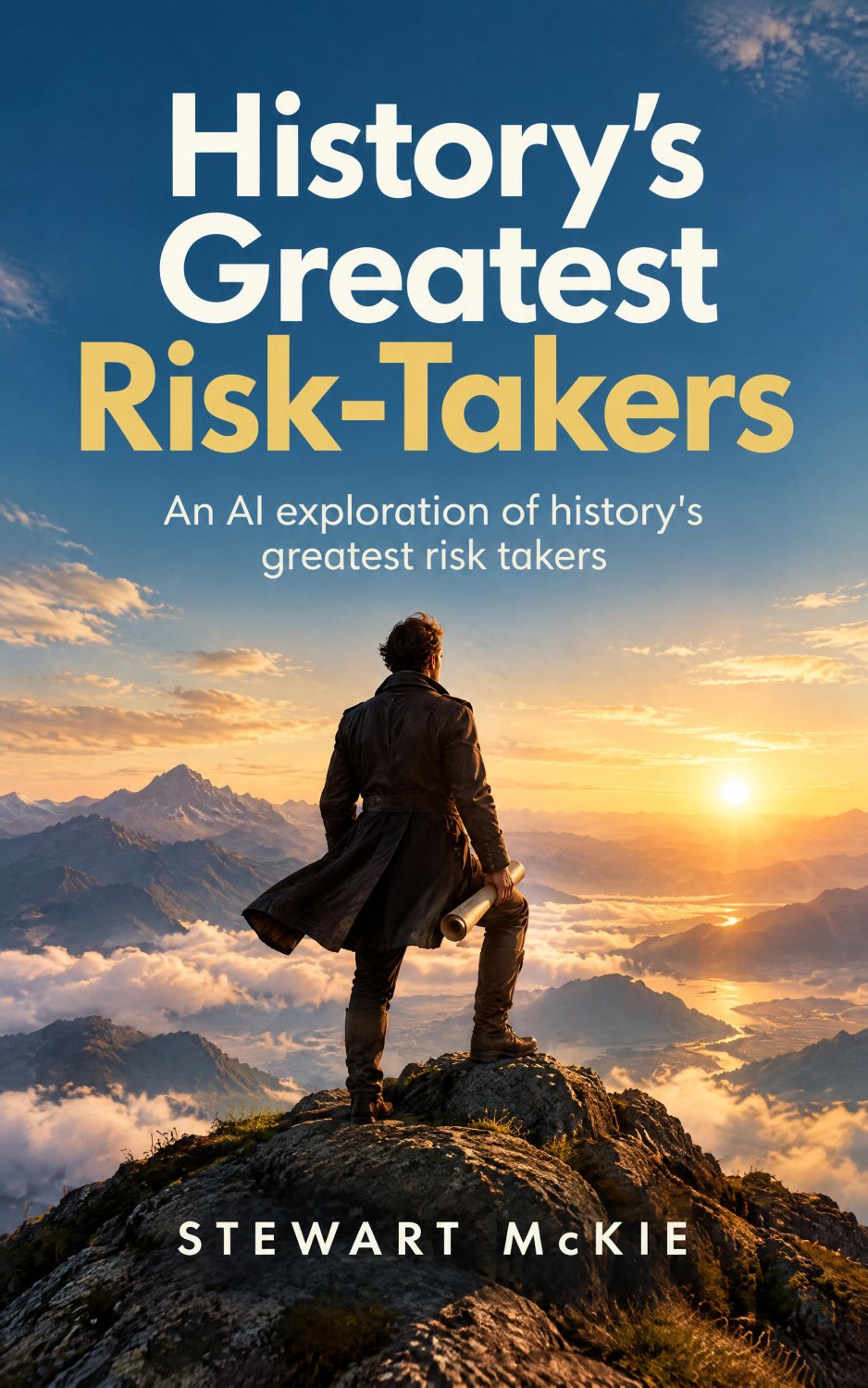
History's Greatest Risk-Takers
An AI exploration of risk-takers who changed the world
AI-generated
Written by AI. Tools: Claude Sonnet 4.6 (outline), Claude Haiku 4.5 (chapters, blurb), via aibookbot · with corrections and notes by the author
Download: PDF 597 KB EPUB 354 KB · The EPUB reflows to fit phones and e-readers.
0 views 0 downloads Published 1 October 2026
What separates the visionaries who reshape history from the reckless who merely destroy it? This book examines fifteen transformative risk-takers from Caesar to Mandela, analyzing not whether their gambles succeeded, but why they chose to take them, what they calculated about their odds, and what consequences actually followed. Stewart McKie explores the intersection of ambition, uncertainty, and historical impact through figures whose decisions altered the trajectory of nations and empires.
History's Greatest Risk-Takers is for readers seeking to understand how individuals navigate impossible choices under incomplete information. Whether your interest lies in military strategy, political philosophy, technological innovation, or human psychology, this book reveals the patterns that distinguish calculated gambles from reckless desperation. You'll discover how even successful risk-takers cannot control the cascading consequences they set in motion, and how this blindness about outcomes shapes history itself.
If you want to understand not just what happened in history, but why certain individuals chose to risk everything when failure seemed plausible, this book offers analytical frameworks and cautionary tales applicable far beyond historical study.
History's Greatest Risk-Takers is for readers seeking to understand how individuals navigate impossible choices under incomplete information. Whether your interest lies in military strategy, political philosophy, technological innovation, or human psychology, this book reveals the patterns that distinguish calculated gambles from reckless desperation. You'll discover how even successful risk-takers cannot control the cascading consequences they set in motion, and how this blindness about outcomes shapes history itself.
If you want to understand not just what happened in history, but why certain individuals chose to risk everything when failure seemed plausible, this book offers analytical frameworks and cautionary tales applicable far beyond historical study.